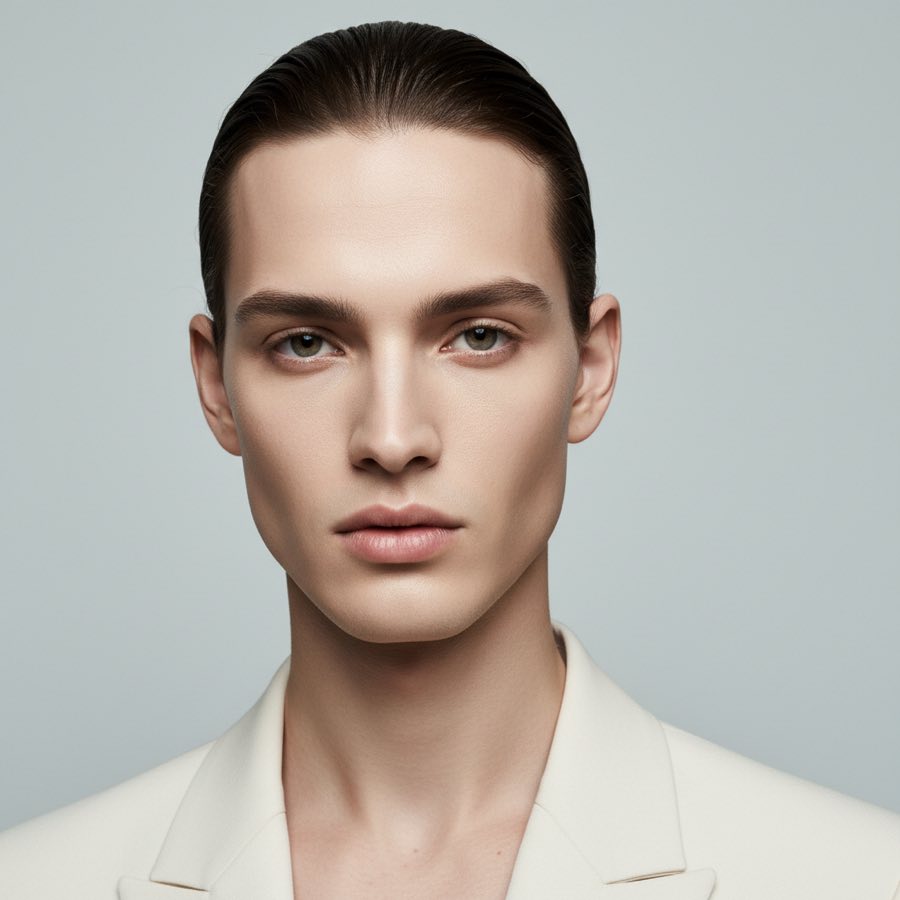
Facial Analysis

See how your face reads.

A precise, descriptive read on your facial proportions — mapped from landmarks into 37 measurements, each compared to published anthropometric ranges and located on your own photo. What your features are, and what you can shape. In seconds.

478-point mesh · 37 cited measurements · results in seconds
Fair across ethnicities

Checked on faces balanced across seven ethnic groups, so it stays consistent for everyone. See the research →

Grounded, not guessed

The engine behind it was tested against thousands of human-rated faces — ~88% agreement. See the research →

30-day money back

Not satisfied with your report? Email us within 30 days for a full refund.

See it in action

A real analysis, on a real face

Exactly what you get — measured on real sample photos through the same pipeline your photo would use. A description of the features, not a rating. Switch between people to see how it reads different faces.

Long face · upturned eyes

25 of 37 proportions sit within the typical range — a description of Woman 1's features, not a rating.

Below are 6 of the 37 measurements we run on every face — frontal proportions and profile angles, each located on the real photo and compared to cited research.

See Woman 1's full report — all 37 metrics →
The engine behind it

Grounded in real human judgement

The model that powers our analysis was tested on thousands of faces that large groups of people had already rated — photos it never saw in training — to confirm it reads faces the way people do. Your report is descriptive: it shows your proportions, not a ranking against others.

0%

the engine's agreement with human raters, on faces it had never seen

5,500 rated faces

Benchmarked on a public research dataset of human-rated faces.

Fair across 7 ethnic groups

Checked on a balanced set so it stays consistent for everyone — not tuned to one population.

Nothing hidden

Every number, chart and method is published — see exactly how we validated it.

See the full research →
How it works

Three steps to your report

1

Upload a photo

One clear, front-facing photo — or use your camera. Takes seconds, no account needed.

2

0 landmarks mapped

Google's MediaPipe mesh locates 478 facial points, corrects for head tilt, and measures the proportions.

3

See your report

A plain-language read of your face plus a metric-by-metric breakdown of your proportions — each with its source, what it means, and the everyday levers you can actually shape.

The technology

How the analysis actually works

Most "face raters" score you against the golden ratio — a convention modern research has largely debunked. We measure your real proportions instead, and make every number transparent and sourced.

Grounded, not guessed

An engine tested against human judgement

The model behind our analysis was validated on large datasets of faces that thousands of people had rated — on photos it had never seen, it reads faces the way people do about 88% of the time, versus a coin-flip 50%. Your report itself stays descriptive: it shows your proportions, not a rating.

See the evidence, with a fairness check across ethnicities →
Precision

A 478-point facial mesh

We locate 478 landmarks, correct for head tilt, and derive 37 proportion and angle measurements — each compared to cited anthropometric research, not folklore.

Fair by design

Checked across ethnicities

We test the score on faces balanced across seven ethnic groups so it stays consistent for everyone — not tuned to one population.

Transparent

We show our work

Every metric has a definition, a source, and an honest caveat where the science is debated — and the engine's accuracy is published in full. No black box.

Why us

Most face-raters judge. We describe.

The internet is full of "looksmaxxing" scores pulled from a Renaissance ratio. Here's how an honest, measured approach is different.

Typical face-raters
Aesthetics
What you get
A single "you're a 7" verdict from a golden-ratio formula
A description of your real proportions, and what you can shape
Evidence
A black box, or no proof at all
Every metric sourced; the engine validated and published
Fairness
Tuned to one "ideal" look
Checked across seven ethnic groups
Speed & price
$50–$150 and days of waiting
$9, and your result in seconds
The report

See exactly what you get

Your read
Tapered jaw · close-set eyes · refined nose
Facial thirds balance1.28 · typical
Canthal tilt+6° · typical
Jaw : cheekbone width0.76 · less common
+ 34 more measurements···

View the full sample report →

The breakdown

37 geometric tests across your face

Your report is a transparent, landmark-by-landmark description of your face: proportions, distances and angles measured from the 478-point mesh, each compared to published ranges and shown with its source. No skin, colour or dental guesses — just geometry, honestly.

  • Eye spacingInter-eye gap relative to one eye width. Classically the gap between the eyes equals the width of one eye.
  • Canthal tiltAngle from inner to outer eye corner. A slight positive (upward) tilt is commonly considered favourable; negative is a downward "sad" tilt.
  • Eye width ratioWidth of one eye (inner to outer corner) relative to the bizygomatic face width. By the rule of fifths the face spans about five eye-widths, so one eye is ~0.2 of the width.
  • Eye aspect ratioOpenness of the eye: vertical eyelid opening divided by eye width. Higher = rounder, lower = narrower.
  • Lower eyelid exposureHow much sclera (white) shows below the iris, as a share of the iris diameter. Around zero — the lower lid resting at the iris — reads as a youthful, supported lower eye. Higher values indicate lower scleral show.
  • Interpupillary ratioDistance between the pupils (iris centers) relative to face width. Near 0.46 is a commonly cited balance point.
  • Intercanthal : nose widthNeoclassical canon: the gap between the inner eye corners should roughly equal the width of the nose.

How this works

  1. 1
    478-point facial mesh. Google MediaPipe Face Landmarker maps your photo to 478 facial landmarks and corrects for head tilt.
  2. 2
    Your proportions, measured. We derive 37 distances and angles from the mesh — facial thirds, fifths, canthal tilt, symmetry, jaw and chin ratios, profile angles and more — and describe how each compares to published anthropometric ranges.
  3. 3
    Described, not graded. Each measurement reads as Each measurement reads as or distinctive — a description, not a verdict. Distinctive proportions are common in striking faces, and many classical "ideals" (like the golden ratio) are debated, so we label them as context.
  4. 4
    Grounded, and we show our work. The model behind the engine was tested against human-rated faces it never saw in training and agrees with people about The model behind the engine was tested against human-rated faces it never saw in training and agrees with people about of the time (a coin flip is 50%). The full evidence — across thousands of faces and a fairness check across ethnicities — is on the research page.

Breakdown grounded in: Farkas 1994, Farkas et al. 1985, Rhodes et al. 1998, Naini 2011. Full citations appear with each unlocked metric.

Pricing

One report, one price

$9 one-time · lifetime · instant

Comparable analyses run $49–$150. 30-day money-back guarantee.

Questions

Before you start

One clear, front-facing photo with even lighting, a neutral expression, and your face unobstructed (hair off the forehead helps). A straight-on angle gives the most accurate proportions; add a side photo to unlock the profile angles. It takes seconds and needs no account.

Ready to see your analysis?

Free read + preview · full report $9 one-time · 30-day money-back guarantee